
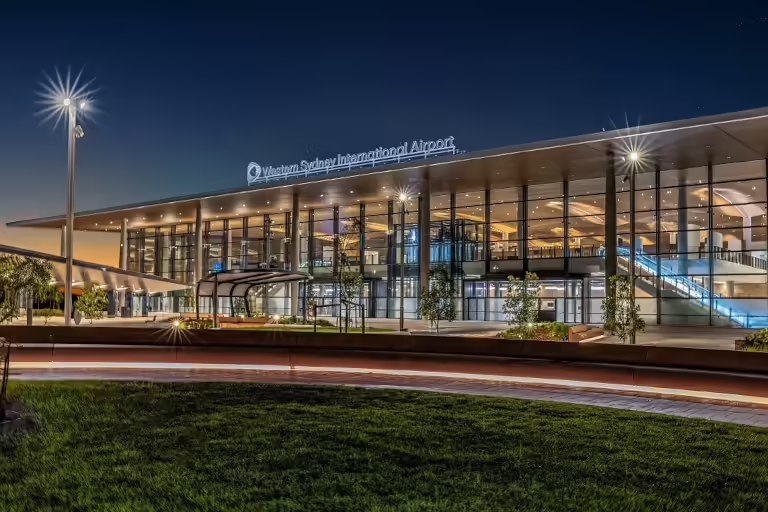
Sydney’s New Airport: First Flight to Take Off in October 2026
Domestic travellers will soon experience significantly improved connectivity across Australia’s busiest flight paths. This morning, Qantas and Jetstar officially launched ticket sales for services operating from the new Western Sydney International (Nancy-Bird Walton) Airport (WSI). These inaugural routes connect the burgeoning Western Sydney region directly to major east coast hubs, including the Gold Coast, Melbourne, and Brisbane. Consequently, the launch represents a pivotal shift in how residents across Greater Sydney access domestic air travel, providing a long-awaited alternative to the traditional Kingsford Smith hub.
| Route Details | Airline | Frequency | Commencement |
|---|---|---|---|
| WSI to Melbourne | Jetstar | 14 flights per week | 25 October 2026 |
| WSI to Gold Coast | Jetstar | 4 flights per week | 25 October 2026 |
| WSI to Brisbane | Jetstar | 3 flights per week | 25 October 2026 |
| WSI to Melbourne | Qantas | 4 flights per week | 28 March 2027 |
| WSI to Brisbane | Qantas | 4 flights per week | 28 March 2027 |
A New Era for Western Sydney Travellers
Sydney’s New Airport CEO Simon Hickey described the ticket launch as a transformative moment for both business and leisure travellers. Residents in Greater Sydney now have more flexibility when planning their journeys along the eastern seaboard because of these new service announcements. Furthermore, the first commercial passenger flight, Jetstar JQ362, will depart for the Gold Coast at 11:00 am on Sunday, 25 October 2026. This milestone marks the official start of operations for the state-of-the-art terminal, which offers a seamless experience for over ten million passengers annually.
Jetstar plans to utilise its Airbus A320 fleet for these initial services, providing capacity for up to 188 passengers per flight. Subsequently, QantasLink will introduce its Embraer E190 aircraft to the hub in early 2027. These smaller jets offer a premium experience, featuring 10 business class seats alongside a standard economy cabin. As a result, the airport caters to a diverse range of travel needs from its first day of operation, ensuring that both budget-conscious holidaymakers and corporate executives find suitable options. Moreover, the airport’s 24-hour operation without a curfew allows for more efficient scheduling, which typically leads to fewer delays and better aircraft utilisation for the carriers involved.
Boosting Global Trade and Logistics
In addition to passenger services, Western Sydney International Airport will play a critical role in Australia’s freight network. The integrated 24-hour Cargo Precinct is scheduled to open on Sunday, 26 July 2026. Qantas Freight will lead the charge, with its first freighter scheduled to depart the following evening. This facility operates without a curfew, which ensures that critical goods move more efficiently across global markets. The precinct’s high-volume logistics design significantly increases Sydney’s overall air cargo capacity and supports the growing demand for e-commerce and rapid delivery services.
The airport’s strategic location provides dedicated access via the recently upgraded Northern Road, which connects the site to major transport arteries. Furthermore, its proximity to major logistics hubs in Kemps Creek and the developing Aerotropolis enhances its appeal to importers and exporters alike. Therefore, WSI is positioned to become a central pillar of Sydney’s industrial growth, supporting businesses as they reach new international destinations. The precinct’s ability to handle temperature-sensitive goods and oversized cargo further strengthens its position as a world-class logistics hub. Consequently, local producers in Western Sydney will find it easier to export their products to Asian and European markets directly from their doorstep.
Government and Industry Support
Federal Minister for Infrastructure Catherine King emphasised that the project has been 15 years in the making. She noted that the gateway represents the hard work of tens of thousands of individuals who have contributed to the planning and construction phases. Similarly, Qantas Group CEO Vanessa Hudson highlighted the airport’s potential to spur local tourism and create thousands of jobs in the region. By providing a closer alternative to Kingsford Smith, the airport makes aviation more accessible for millions of residents who previously faced long commutes to catch a flight. This accessibility is expected to drive significant economic benefits, including increased spending in local hospitality and retail sectors.
Ultimately, the launch of these domestic services represents a significant vote of confidence in the region’s future. While global challenges continue to affect the aviation industry, the rapid development of WSI suggests a bright outlook for Greater Sydney’s connectivity. Travellers can now book their flights and prepare for a new way to explore the nation from late 2026. As the airport nears completion, officials expect further announcements regarding international carriers and additional domestic routes to solidify WSI’s status as Australia’s premier 24-hour gateway. Ongoing investment in surrounding infrastructure, including the new Sydney Metro – Western Sydney Airport line, ensures the airport’s full integration into the city’s broader transport network from day one.
Source: Western Sydney International Airport Media Release
Cheap Flights to Sydney

Visiting Sydney: The Ultimate Guide
Visiting Sydney? Discover Expert Tips, Must-See Attractions, and Insider Advice for an Unforgettable Australian Adventure.
Trending Posts

Australian Universities Admission: Gaokao Scores Drive Record Chinese Enrolments
The share of Chinese mainland students utilising gaokao scores for direct admission to Australian universities rose to 73.7 . . .